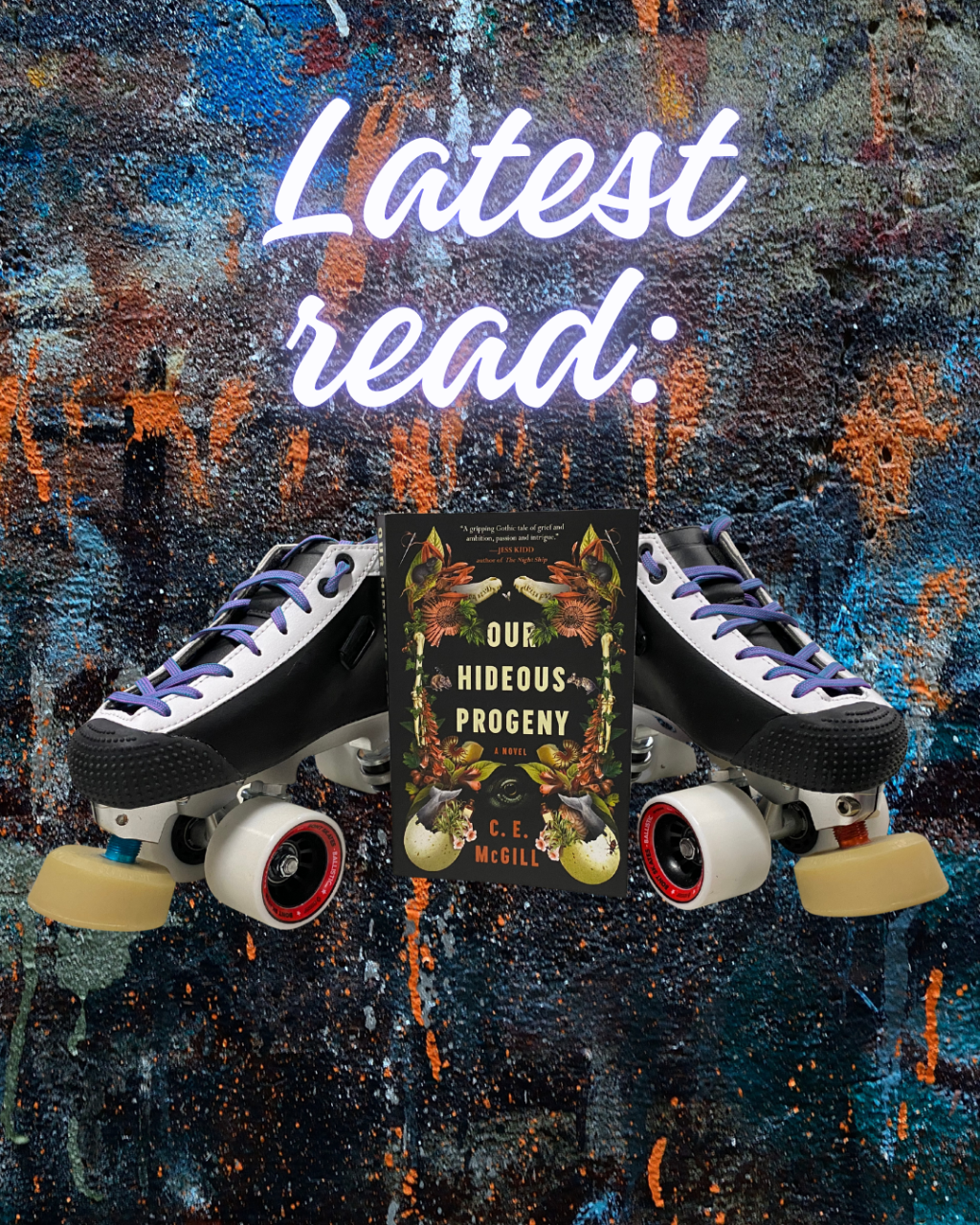
Our roller derby team has a book club. Because, yes, roller derby humans are tough on the track, but off the track a bunch of us are just book nerds looking to talk to other book nerds about our favorite books. For our book club, we all give suggestions and we use a randomizer wheel to choose the book. The last book was “Our Hideous Progeny” by C.E. McGill.
This tale is a part retelling and part “sequel” of “Frankenstein” by Mary Shelley. It follows a woman in the mid-1850s. Mary is a woman who loves science. She doesn’t really have a place in the world of science, but luckily the uncle of a childhood friend and her husband both help her stay involved in that world. She especially loves paleontology, fossils, and imagining what old creatures would have been like.
Ultimately, Mary finds her great-uncle’s (Victor Frankenstein’s) notes on a creature he brought to life. She and her husband decide to recreate his experiments, and the bulk of this story follows those experiments and the push and pull between a husband and a wife and their colleagues.
On the surface, I expected this fiction piece to lean towards science fiction and horror the way that Shelley’s “Frankenstein” did, but instead I was surprised to find it was so much deeper than that. McGill weaves a tale of womanhood and the expectations put on women of the time to be wives and mothers and nothing else. Mary’s exploration of science makes her less acceptable to the general community, and she is often chided for being too brash. McGill also explores what it would have been like to be queer in the 1850s: being unable to act on the “unnatural” feelings one has, and the fear of misreading situations and losing friendships because of blossoming romantic feelings. I thought this was handled delicately, and, while it was a large part of who Mary was, it didn’t feel forced or inauthentic.
I loved the way the author chose to explore motherhood and “motherly instincts.” Mary and Henry have lost a child, and this has driven a wedge into their marriage. Rather than focusing on wanting to try for more children, McGill instead explores what it is like for a woman to not have children and not really want any. The compassion that Mary feels for others is often perceived as motherly, like she is finding a replacement for the child she has lost, but to me she just feels like a compassionate woman who loves with her whole heart and recognizes the values in not only humans, but also creatures she encounters.
Overall, I found this to be a really interesting read. It started a little slow for me, but what really kept me going was the depth of the characters McGill created. It was so much more than a “Frankenstein’s monster” tale; it was a poignant tale of a woman who stayed strong despite not fitting perfectly into the expectations of society. If you read this, definitely stick around for the Author’s Note!
 Smashbox Twenty
Leave a comment